
Japanese International School Begins Construction of Groundbreaking IB Campus in Phnom Penh
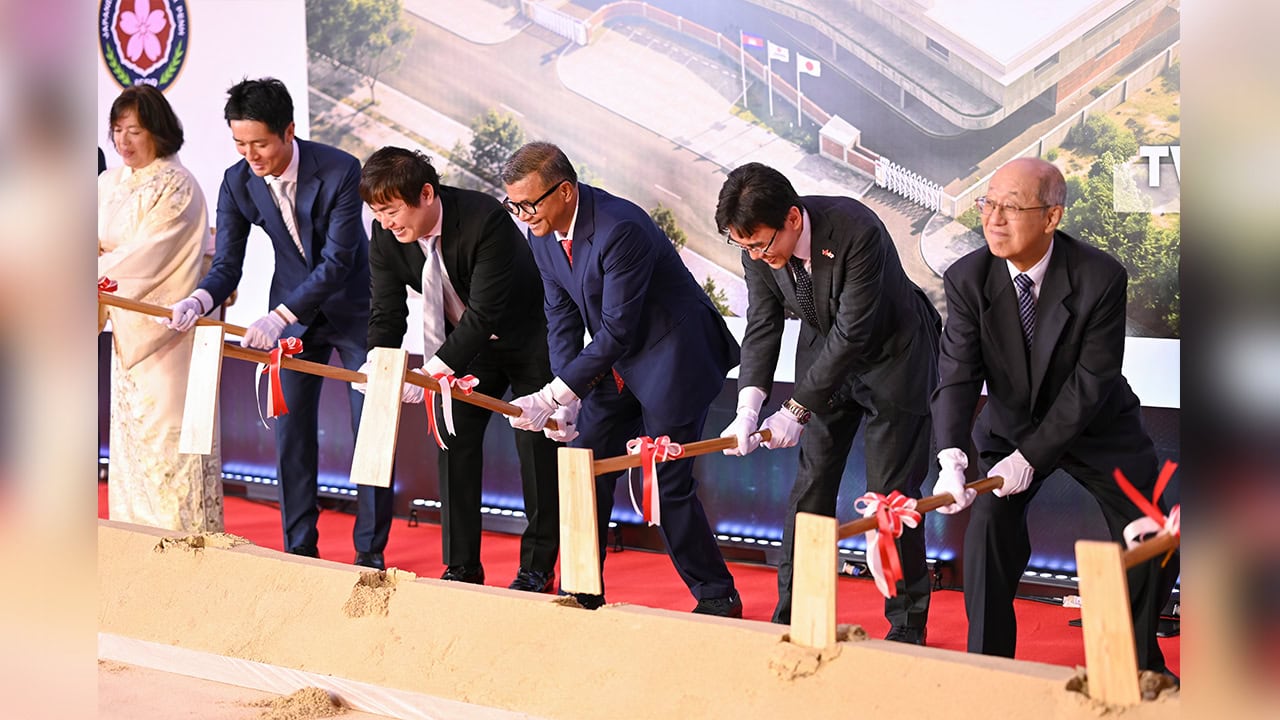
Under the banner "Two Schools, One Future," a new project in Phnom Penh aims to bring together a Japanese government-accredited school and an International Baccalaureate (IB) school on a single site, creating what organisers describe as a first-of-its-kind learning environment for Cambodia.
The Japanese International School of Phnom Penh (JISPP) held a groundbreaking ceremony for its new campus in Khan Mean Chey on September 22. The site is set to become the first place anywhere in the world where an IB school spanning kindergarten through middle school shares a campus with a school accredited by the Japanese government.
The ceremony was led by H.E. Dr. Hang Chuon Naron, Deputy Prime Minister and Minister of Education, Youth and Sport. Also in attendance were Mr. Misumi Takahito, Chargé d’Affaires a.i. of the Embassy of Japan, along with representatives from the Japan International Cooperation Agency (JICA) and members of Cambodia's Japanese community.
Due to open in August 2027, the JISPP Mean Chey Campus lies roughly one kilometre south of AEON Mall Mean Chey. It will extend JISPP's existing early childhood program up through middle school and will also become the new base for the Japanese School of Phnom Penh (JSPP), which is accredited by Japan's Ministry of Education (MEXT).
The event followed a visit to Cambodia two weeks earlier by Japan's Minister of Education, Culture, Sports, Science and Technology, Mr. Yohei Matsumoto, who agreed with H.E. Dr. Hang Chuon Naron to strengthen educational ties between the two nations.
A World-First Dual-Campus Approach for Japanese and IB Education
The Mean Chey Campus will be the world's first to house both a Japanese government-accredited school and an IB school covering the full range from kindergarten through middle school. Although some Japanese accredited schools abroad already share buildings with international schools, this project is unique in allowing students of the same ages from both schools to grow up together within a single shared community over their entire school journey.
The two institutions will operate under the shared idea of "Two Schools, One Future."
Each school will keep its own curriculum — Japanese pupils will follow the program set by Japan's education ministry, while JISPP students will receive an education that blends Japanese teaching methods with the IB framework. At the same time, the design deliberately builds in joint extracurricular activities, shared campus events, and everyday interaction between students of both schools.
The campus has been planned around the daily needs of young children, featuring generous play areas, a football field, a swimming pool, sports facilities and a canteen. Its design draws heavily on natural light and natural materials, in keeping with Japanese school-design principles.
Combining Japanese Education with IB Inquiry
JISPP first opened in 2024 as a nursery and kindergarten, serving Cambodian, Japanese and other international families. It is currently an IB candidate school, working towards authorisation for the Primary Years Programme.
At the ceremony, H.E. Dr. Hang Chuon Naron spoke warmly of Japan's education system, praising its focus not just on academic learning but also on building discipline, responsibility, teamwork, respect for others and a strong sense of community. He also underlined the value of the IB approach in helping students think for themselves, ask questions and search for solutions — abilities he called essential for the 21st century.
He added that uniting the two schools, each with its own strengths, on one campus would give Cambodian and Japanese children a valuable chance to learn side by side, better understand one another's cultures and form friendships from a young age. Such bonds, he suggested, could act as a bridge to further deepen the relationship between Cambodia and Japan in years to come.
JISPP combines the best of Japanese education with the inquiry-based learning of the IB through a student-centred model. Children are encouraged to pursue their interests and curiosity, make their own choices and experiment. This nurtures not only academic ability but also key non-cognitive qualities such as independence, confidence, perseverance, creativity and cooperation.
Japanese education also stresses learning through everyday routines. Children clean their classrooms, serve one another lunch, look after their own belongings and take part in school activities — experiences that foster responsibility, self-reliance and thoughtfulness towards others.
Learning extends beyond the classroom as well. JISPP values outdoor play, where children connect with nature, explore and take on challenges suited to their age. Using their heads, hearts and hands, they learn to solve problems, learn from their mistakes and discover their own capabilities.
Alongside Japan's traditional strengths in mathematics and science, the IB approach prompts children to ask questions, explore ideas and arrive at their own answers. Together, these methods aim to raise children who can think independently, act on their own initiative, collaborate with others and meet new challenges with confidence.
"I sincerely hope that this new campus will become a place that brings together Japanese and Cambodian children and that the children who learn here will grow up to act as bridges of friendship between our two countries in the future," said Mr. Misumi Takahito of the Embassy of Japan in Cambodia.
The Story of the Japanese School of Phnom Penh
The Japanese School of Phnom Penh opened on May 31, 2015, with just 27 students. It was created through the combined efforts of the Embassy of Japan, the Japanese Association of Cambodia, the Japanese Business Association in Cambodia and the broader Japanese community.
H.E. Dr. Hang Chuon Naron attended the school's opening ceremony back in 2015 and returned to preside over the groundbreaking of its future home.
"It is truly meaningful that the Japanese School of Phnom Penh will share a new campus with JISPP. Having children from both schools learn together and interact with one another will create tremendous educational value," said Koji Tezuka, President of the Japanese Association of Cambodia, which oversees JSPP.
A Book Donation to the Ministry
During the ceremony, JISPP and Sunrise Japan Hospital Phnom Penh donated 50 copies of a newly released Khmer-language book on early childhood education to the Ministry of Education, Youth and Sport. Written by Mr. Watanabe in partnership with the hospital, the book gives parents practical advice grounded in the Japanese approach to child development. The cover carries a message from H.E. Dr. Hang Chuon Naron.
From EdTech to a Next-Generation Campus
JISPP's founding partner, Wonderfy Inc., has worked in Cambodian education since 2018, when it launched a project with JICA to strengthen mathematics and science teaching using its thinking-skills app, Think!Think!.
"Our journey in Cambodia began with a JICA project in 2018. Today we break ground on a campus that will carry these children from kindergarten through middle school. As a bridge between Japan and Cambodia, we will pursue the very best education here," said Kei Kawashima, CEO of Wonderfy Inc.
About JISPP
The Japanese International School of Phnom Penh (JISPP) is a nursery and kindergarten in Phnom Penh that provides Japanese early childhood education to children of every nationality. It is an IB candidate school and collaborates closely with the Ministry of Education, Youth and Sport. Opening in August 2027, the JISPP Mean Chey Campus will extend the school through primary and middle school.